Los Angeles County enforces strict geotechnical review, and Torrance sits right where the Newport-Inglewood fault zone shapes everything below grade. Builders here know that standard SPT data from a hollow stem auger might miss thin liquefiable lenses or soft clay pockets that CPT picks up at every centimeter. Our team runs ASTM D5778 cone penetration tests with pore pressure measurement, delivering real-time stratigraphy that feeds directly into ASCE 7 seismic site class determination and IBC foundation design. For projects east of Western Avenue, where the soil transitions from recent alluvium to older Pleistocene deposits, the continuous sleeve friction and tip resistance profiles give structural engineers the confidence to optimize footing sizes instead of overconserving. When time matters on a tight 90-day permit window, CPT eliminates the wait for lab consolidation results and reduces the number of borings required by the city plan checker.
We also cross-check CPT data with selective SPT drilling when the project geologist needs physical samples for Atterberg classification or to calibrate the friction ratio against known local formations like the San Pedro sands.
A single CPT sounding replaces three to four SPT borings for seismic site class determination when pore pressure data confirms the drainage condition of each layer.
Service characteristics in Torrance
For deeper investigations or sites with dense gravel interbeds near the Palos Verdes boundary, we pair CPT with complementary methods like the plate load test to confirm bearing capacity at shallow foundation elevations.
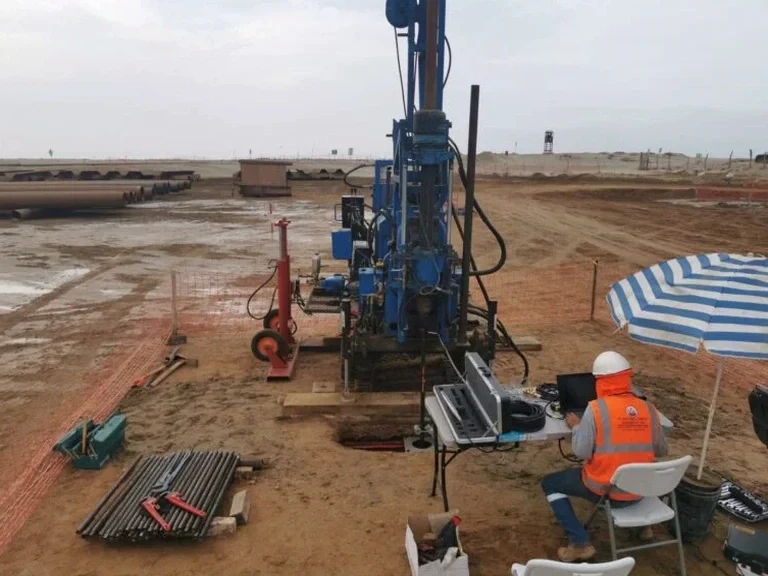
Local geotechnical conditions in Torrance
Torrance grew fast after World War II, with thousands of homes and low-rise commercial buildings placed on former agricultural land before modern geotechnical codes existed. Much of the flat terrain between Hawthorne Boulevard and the 405 freeway sits on Quaternary alluvium that includes discontinuous lenses of loose sand and soft clay—materials that liquefaction studies by Seed and Idriss identified as problematic in the 1970s and that still dictate foundation costs today. The fault proximity means site-specific ground motion amplification can vary across just two blocks, and ASCE 7 Chapter 20 requires site class determination based on the upper 100 feet of stratigraphy. CPT provides the continuous shear wave velocity proxy needed to nail that classification without drilling multiple deep borings. Missing a thin saturated silt layer at 25 feet can shift a site from Class D to Class E, triggering a full dynamic analysis that adds six weeks to the structural design phase. We have seen this exact scenario on Crenshaw Boulevard projects where older geotechnical reports relied on SPT blow counts alone and underestimated the thickness of compressible interbeds.
Our services
Every CPT job in Torrance runs a little differently depending on whether we are dealing with refinery pad expansions, school seismic retrofits, or infill multi-family construction. Our equipment and reporting adapt to the specific demands of each project type.
Seismic Site Classification CPT
We push to 65-100 feet across multiple locations on a single mobilization day, measuring tip resistance and pore pressure continuously. The data feeds directly into the ASCE 7 shear wave velocity correlation, allowing the project geotechnical engineer to assign a definitive Site Class (C through F) without waiting on downhole seismic testing. For Torrance Unified School District modernizations, this approach has cut the geotechnical investigation phase from three weeks to five working days.
Liquefaction Triggering and Settlement Analysis
Using CPT-based methods from Boulanger and Idriss, we evaluate the cyclic resistance ratio of every soil layer to the design earthquake. The continuous pore pressure record identifies contractive sands that SPT sampling might drain before they reach the lab. On a recent warehouse project near the Torrance Airport, the CPT data demonstrated that a 4-foot-thick silty sand at 22 feet would not trigger liquefaction under the MCE event, saving the owner from a $200,000 deep foundation upgrade.
Common questions
How much does a CPT test cost in Torrance?
For a standard CPT sounding to 60-65 feet depth within the Torrance area, the cost typically falls between US$160 and US$210 per location, assuming reasonable access and no pre-drilling through hard fill. The final number depends on the total linear footage, the number of push locations, and whether pore pressure dissipation tests are required at specific depths. Most commercial building projects budget for three to five soundings to satisfy the city plan checker.
Does the City of Torrance accept CPT data for foundation design submittals?
Yes, the Torrance Building and Safety Division accepts CPT logs as part of the geotechnical investigation package, provided the data is correlated with at least one physical boring or test pit for soil classification verification. The CPT report must include the cone resistance, sleeve friction, friction ratio, and pore pressure profiles, and it should reference the applicable ASTM D5778 standard and ASCE 7 site classification methodology. We have submitted CPT-based reports for projects ranging from single-family additions to multi-story mixed-use buildings.
What depth can your CPT rig reach in Torrance soils?
Our standard 20-ton truck-mounted rig typically reaches 65 feet in the alluvial soils common across most of Torrance. In areas with dense gravel or cobble layers, like the foothill transition zone near Palos Verdes Boulevard, refusal may occur shallower. When the project requires depths beyond 65 feet, we can pre-drill through hard layers or mobilize a larger 30-ton rig that reaches 100 feet in most conditions.
What is the difference between CPT and SPT for Torrance projects?
CPT provides a continuous vertical profile of soil behavior—every centimeter of depth is recorded—while SPT only gives data at 5-foot intervals from a disturbed sample. In Torrance, where thin liquefiable sand seams and compressible silt lenses control foundation performance, the continuity of CPT data is a significant advantage. That said, SPT provides a physical sample for visual classification and Atterberg limits, so many projects use CPT for the bulk of the investigation and one or two SPT borings for material verification.
How long does a CPT investigation take?
A standard three-location CPT program in Torrance can be completed in a single day, including mobilization, setup, pushing, and demobilization. Each push to 60 feet takes approximately two to three hours, depending on soil conditions and whether pore pressure dissipation tests are run at specific horizons. The data is available in digital format the same evening, and the final interpreted report with soil behavior type classification and seismic parameters is typically delivered within three to five business days.