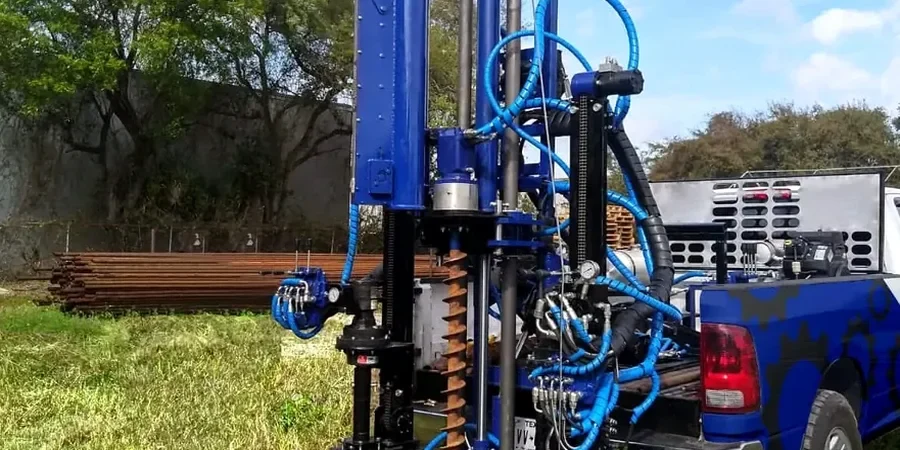
The CME-75 drill rig drops a 140-pound hammer from 30 inches — that consistent thud is the Standard Penetration Test at work beneath Torrance. Our crew sets up the automatic trip hammer on sites from Old Torrance to the industrial corridors near the 405, driving a split-spoon sampler into the coastal plain sediments that define this part of Los Angeles County. Each 18-inch drive records the blow counts that tell us exactly how dense the soil is at depth. We log every sample as it comes up: color, moisture, gradation visible to the eye. The SPT isn't just a number — it's a physical record of what's under the slab. When we hit the Pleistocene Lakewood Formation at 15 or 20 feet, the resistance jumps, and that transition zone matters for bearing capacity calculations. For deeper investigation in the fine-grained deposits common near Torrance's historic marsh areas, we often pair the SPT program with a CPT test to capture continuous stratigraphic profiles without sample disturbance.
N-values from Torrance's upper 30 feet drive the liquefaction assessment — the City checks them against the latest California Geological Survey seismic hazard maps.
Service characteristics in Torrance
Local geotechnical conditions in Torrance
Torrance sits squarely within Seismic Design Category D as defined by ASCE 7-22. The city's population of just over 143,000 lives atop sediments that experienced strong shaking during the 1994 Northridge earthquake — M6.7 at roughly 20 miles from the epicenter, enough to trigger scattered liquefaction in low-lying areas near the former marshlands. SPT blow counts below 15 in saturated silty sand layers at depths shallower than 50 feet activate the simplified liquefaction evaluation procedure originally developed by Seed and Idriss. A single boring that misses a loose lens can lead to a foundation design that performs poorly during the next significant event on the Newport-Inglewood Fault, which runs just a few miles east of Torrance Boulevard. The California Geological Survey's regulatory maps designate portions of the city within liquefaction hazard zones — triggering mandatory investigation under CBC Chapter 18 when public buildings or essential facilities are involved.
Our services
Our SPT program in Torrance covers the full chain: field drilling with truck-mounted CME rigs, in-situ logging, sample transport to our lab, and a geotechnical report signed by a California-licensed engineer. Every project includes N60 energy correction and correlation to standard soil parameters.
SPT Borehole & Sampling Program
One to multiple borings to 50 ft typical depth using hollow-stem auger drilling. Split-spoon sampling at 5 ft intervals and at every stratum change. We log blow counts, groundwater, and recovery for direct input into bearing capacity and settlement calculations.
SPT-Based Liquefaction Analysis
N-values corrected to N60 and fines content from companion lab testing feed the simplified Seed-Idriss procedure. We map factor of safety against liquefaction per depth and carry out lateral spreading displacement estimates where the California Geological Survey hazard zone applies.
Common questions
How much does an SPT boring cost in Torrance?
For a typical single boring to 30–40 feet depth with sampling at 5-foot intervals, the cost ranges from US$580 to US$720 per boring. Mobilization, traffic control if required, and lab classification testing are additional. Projects requiring multiple borings or deeper investigation will scale accordingly.
How deep do SPT borings need to go for a Torrance residential project?
Most single-family residential projects in Torrance require borings to 25–35 feet, or at least 10 feet below the deepest proposed footing, whichever is deeper. The City's building department reviews depth based on the geotechnical engineer's recommendation and the presence of liquefiable layers in the upper 50 feet.
Does Torrance require SPT testing for building permits?
Yes. The City of Torrance Building & Safety Division requires a soils report prepared by a California-licensed geotechnical engineer for new construction and significant additions. SPT borings are the standard method to satisfy CBC Chapter 18 requirements for subsurface investigation, particularly in the mapped liquefaction hazard zones.
How long does an SPT investigation take from start to report?
Field drilling for one to two borings typically completes in one day. Lab classification of the recovered samples takes 3 to 5 business days. The geotechnical report with bearing capacity recommendations, liquefaction analysis, and foundation parameters is usually delivered within 10 to 14 business days after drilling.
What soil types do SPT blow counts measure in the Torrance area?
Torrance geology includes the Pleistocene Lakewood Formation (dense silty sands and clays), younger alluvium from the Los Angeles River system, and localized artificial fill over former marsh deposits. SPT N-values range from single digits in loose saturated sands to refusal (50+ blows) in older Pleistocene strata, providing direct correlation to relative density and consistency for foundation design.