The old alluvial fans that sweep across Torrance look flat and forgiving, but the subsurface tells a different story. Much of the city sits on Quaternary deposits where silty clays alternate with loose sands, and groundwater can be as shallow as 15 feet in the lower-lying tracts near the 110 freeway. When you combine that with a design spectrum that pushes short-period accelerations past 1.2g per ASCE 7-22, a conventional isolated footing often becomes a gamble. A stiffened raft foundation spreads column loads across the entire footprint, bridging soft lenses and cutting differential settlement to fractions of an inch. We work with structural teams on footings when conditions allow, but for mid-rise mixed-use along Hawthorne Boulevard the mat is usually the safer call—and actually simpler to waterproof once you detail the mud slab and membrane right.
A properly tuned modulus of subgrade reaction from site-specific Torrance data can cut reinforcing steel tonnage by 8-12% compared with a conservative textbook assumption.
Service characteristics in Torrance
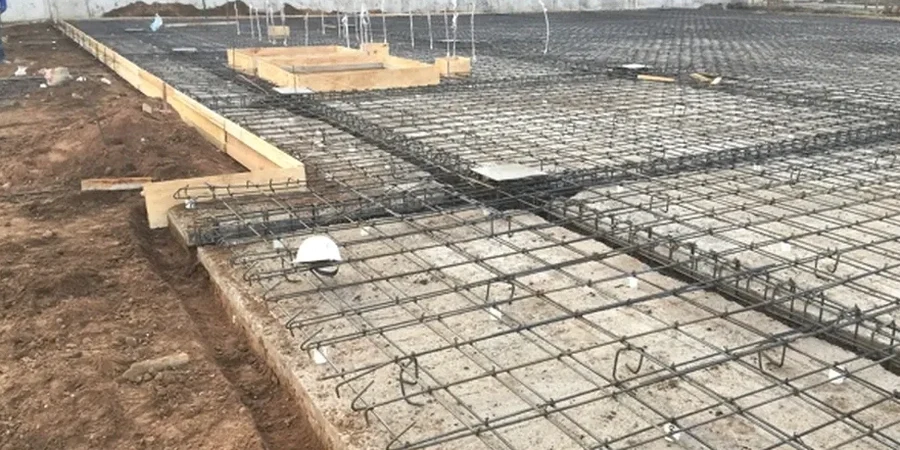
Field demonstration
Local geotechnical conditions in Torrance
In Torrance, we often see builders treat a mat foundation as a simple slab thickening exercise—add a few bars, call it good. The problem shows up two years later when a corner of the building settles half an inch more than the center because the mat was designed for uniform bearing and the soil wasn't. The old Torrance oil-field zones add another wrinkle: undocumented backfill and residual hydrocarbon staining can degrade concrete over time unless the mix design addresses sulfate exposure per ACI 318-19 Table 19.3.1.1. A geotechnical investigation that stops at 30 feet can also miss a deep loose sand layer that liquefies and temporarily loses bearing capacity during a design-level earthquake. When that happens, even a thick mat can tilt if the ground improvement wasn't designed into the subgrade from the start.
Our services
Our geotechnical group supports Torrance projects from preliminary grading plan through final mat inspection, keeping the workflow tight so the foundation design doesn't hold up the structural permit set.
Mat Foundation Feasibility & Parameter Report
Site-specific modulus of subgrade reaction, allowable bearing pressure after settlement analysis, and liquefaction screening per CBC Section 1804. Delivered as a sealed report ready for your structural engineer.
Soil-Structure Interaction Modeling Input
Layered soil springs (vertical and lateral) for SAFE or RISA models, derived from CPT and laboratory consolidation data so the mat deflection profile matches the real ground response.
Subgrade Preparation & QA/QC
Compaction verification, proof rolling observation, moisture conditioning specs for expansive near-surface clays, and concrete pour monitoring to confirm cover and reinforcement placement.
Common questions
When does Torrance building code require a mat foundation instead of isolated footings?
The code doesn't mandate a mat outright, but it becomes the practical choice when the allowable bearing pressure is low (less than 2000 psf), differential settlement between columns would exceed ½ inch, or the water table is high enough that individual footings would need a continuous waterproofing system anyway. Many Torrance mixed-use buildings on the old alluvium default to a mat because the structural mat also serves as the ground-floor slab, saving forming costs.
How much does a raft foundation design package cost for a typical Torrance lot?
For a standard commercial pad in Torrance—field exploration, lab testing, and the geotechnical design report with modulus values—the range typically falls between US$960 and US$4,420 depending on the number of borings or CPT soundings and whether liquefaction analysis is triggered. Projects with deep oil-field backfill or slope adjacency run toward the upper end because the investigation scope expands.
Can you design a mat foundation on Torrance's expansive soils without overexcavation?
Sometimes, yes. If the near-surface clay has a moderate expansion index and the mat is stiff enough to resist heave curvature, we can keep the subgrade in place and specify a moisture-conditioned buffer layer plus a slip sheet. But in pockets where the clay is highly plastic and the groundwater fluctuates seasonally, partial removal and recomaction with less expansive fill is the safer long-term solution.
Does a mat foundation eliminate the need for deep piles in Torrance?
Not always. A mat can handle moderate liquefaction-induced settlement if the post-liquefaction bearing is adequate, but for high-rise towers or essential facilities where zero tilt is required, we sometimes combine a mat with ground improvement such as stone columns or even deep piles that transfer load below the liquefiable layer. The mat then acts as a rigid pile cap.
What kind of site testing do you need before designing a mat foundation here?
At minimum, we run two to four borings or CPT soundings to at least twice the mat width, with sampling for consolidation, swell, and shear strength. If groundwater is encountered within 50 feet, we install piezometers for seasonal monitoring. In Torrance's mapped liquefaction zones, we add downhole shear-wave velocity testing so the liquefaction triggering analysis per ASCE 7 Chapter 21 has real site-specific data.