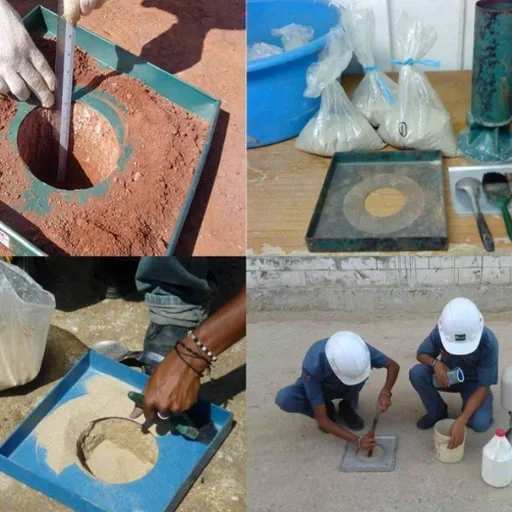
Torrance sits at 89 feet above sea level, over a mix of old alluvial deposits and engineered fill that has supported industrial growth since the 1940s. The 2024 Palos Verdes fault zone mapping reinforced what local geotechnical engineers already knew: fill compaction matters here. We run the field density test (sand cone method) on trench backfills, utility corridors, and structural pads across the city, from the refinery district to the commercial strips along Hawthorne Boulevard. Each test provides a direct measurement of in-place dry density and moisture content, giving contractors a compaction curve comparison on the spot. For deeper stratigraphy beneath the fill, we often pair the sand cone with an SPT drilling program to confirm bearing layers before placing structural fill.
A sand cone test in Torrance isn't just a number on a report. It's the difference between a settlement problem in five years and a floor slab that stays flat.
Service characteristics in Torrance
Local geotechnical conditions in Torrance
In Torrance, we see too many trench patches fail because the inspector relied on a nuclear gauge reading without a sand cone backup on fill containing crushed concrete or slag. The sand cone method avoids the calibration drift and chemical interference that plague nuclear devices in recycled aggregates. The real risk is testing too shallow or skipping the moisture correction. A dry density reading without oven-dried moisture content is just half the data. On one utility trench along Crenshaw Boulevard, initial readings showed 91% compaction; after correcting for moisture that was 4% below optimum, the adjusted value dropped to 88%, triggering a re-compaction order. That correction saved a future asphalt patch failure. The IBC and local Torrance Public Works standards both require this level of verification on any fill that supports pavement or foundations.
Our services
Our Torrance field density service covers the full cycle from pre-test calibration to final report. We show up with ASTM C778 graded sand, a calibrated density apparatus, and a field oven. Every test is documented with location, lift number, dry density, moisture content, and relative compaction against the lab Proctor.
Compaction Verification on Structural Fill
Sand cone testing per ASTM D1556 on building pads, parking lot subgrades, and retaining wall backfill. We test each lift before the next one goes down, with same-day reporting to keep your earthwork schedule on track.
Utility Trench Backfill Testing
Compaction verification on water, sewer, and storm drain trenches per City of Torrance Public Works standards. We coordinate with the contractor to test at specified intervals and carry out stamped reports for the inspector's sign-off.
Common questions
How much does a field density test with the sand cone method cost in Torrance?
A single sand cone density test on a Torrance job site typically runs between US$100 and US$130, depending on access conditions and the number of tests scheduled per mobilization. Volume discounts apply for projects requiring 10 or more tests on the same day.
How long does a sand cone test take on site?
The field portion takes about 15 to 20 minutes per location, including excavation, sand pouring, and sample collection. Weighing and moisture determination add another 30 minutes with a field oven, so you typically have the final dry density and percent compaction within an hour.
Can the sand cone method be used on soil with gravel larger than 1.5 inches?
ASTM D1556 is intended for soils with maximum particle size up to about 1.5 inches. For fill containing larger gravel or cobbles, we recommend a replacement method using a larger test hole volume or switching to a water balloon volume meter in conjunction with a plate load test for overall modulus verification.
What compaction standard does the City of Torrance require for building pads?
The City of Torrance follows the California Building Code with IBC Chapter 17 amendments. Typically, structural fill under building pads must achieve a minimum of 90% relative compaction based on the laboratory maximum dry density per ASTM D1557 (modified Proctor). The project geotechnical report may specify a higher percentage, often 95%, for moisture-sensitive soils common in the Torrance area.