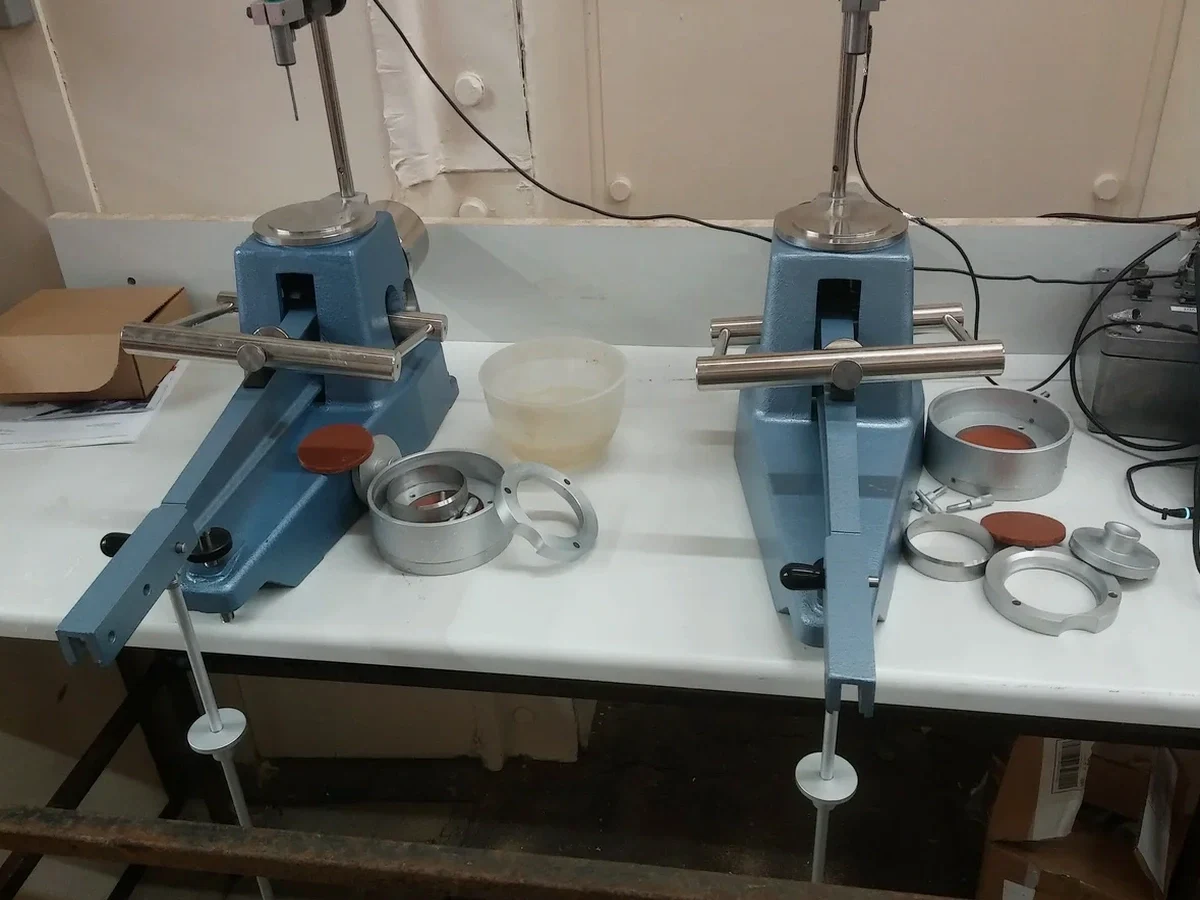
When you're developing property in Torrance, the soil beneath your feet tells a story that directly impacts your foundation costs. The city sits on the Los Angeles coastal plain, where marine sediments and alluvial deposits create wildly variable subsurface conditions. ASTM D4318 testing gives us the liquid limit, plastic limit, and plasticity index—numbers that determine whether your soil behaves more like a solid or a fluid under load. Our lab processes samples from across Torrance, from the slopes near Palos Verdes to the flatlands around the 405 corridor. We see fat clays with plasticity indices exceeding 40 in some zones and lean silts with marginal plasticity just blocks away. Getting this classification wrong triggers expensive over-excavation or, worse, differential settlement that cracks slabs within the first rainy season. The grain size distribution often complements these results when we need the full USCS classification picture.
A plasticity index above 25 in Torrance's marine clays means your foundation design must account for seasonal volume changes or you'll be chasing cracks forever.
Service characteristics in Torrance
Local geotechnical conditions in Torrance
With a population of roughly 147,000 people and a building stock that expanded heavily during the post-war boom, Torrance has thousands of structures sitting on soils that were never properly classified. The city's location just 12 miles from the Palos Verdes Fault zone adds a seismic dimension that makes plasticity data non-negotiable. Cyclic loading during an earthquake can trigger strength loss in sensitive clays with high liquidity indices. We've investigated several commercial properties along Hawthorne Boulevard where previous construction simply ignored the expansive clay layers at 4 to 8 feet depth, resulting in slab heave that required costly underpinning. A project on Crenshaw Boulevard avoided a six-figure repair bill because the Atterberg results flagged the expansive zone early, allowing the structural engineer to specify a suspended slab with a properly vented crawl space instead of a slab-on-grade. That's the ROI of getting the soil classification right before concrete hits the ground.
Our services
Atterberg limits are rarely requested in isolation. Most Torrance projects combine classification with other index and strength tests to build a complete geotechnical profile.
Full Index Testing Package
We pair ASTM D4318 with grain size analysis (sieve and hydrometer) to deliver a complete USCS classification and the AASHTO group index for pavement subgrade evaluation.
Expansive Soil Screening
For Torrance residential lots, we run Atterberg limits alongside swell-consolidation testing to quantify heave potential and recommend foundation type and moisture conditioning requirements.
Common questions
What does Atterberg limits testing cost for a single sample in Torrance?
For a single sample tested per ASTM D4318, expect to pay between US$60 and US$90 depending on sample condition and whether you need the full liquid limit, plastic limit, and plasticity index report. Most projects require multiple samples from different depths, so we typically quote by the borehole rather than per sample.
How long does it take to get results from Atterberg limits testing?
Standard turnaround is 3 to 5 business days from when the sample arrives at our lab. We can accommodate 24-hour rush processing when foundation decisions are holding up the job, though availability depends on current lab workload.
Do I need Atterberg limits if I already have a grain size analysis?
Yes, they measure different properties. Grain size tells you particle distribution; Atterberg limits tell you how the fine fraction behaves with water. A soil can have identical gradation but completely different plasticity depending on clay mineralogy. For classifying fine-grained soils under ASTM D2487, both tests are required to assign the correct USCS symbol.