The marine-influenced soils of Torrance — sitting atop the ancient alluvial fan of the Los Angeles Basin with a persistent shallow groundwater table barely 20 to 30 feet below surface in many sections — create real challenges for pavement engineers. The city’s 145,000 residents and the heavy industrial traffic moving through the refinery corridor near Crenshaw Boulevard demand road sections that will not rut or crack prematurely. A laboratory CBR test, run to ASTM D1883 and AASHTO T 193, cuts through the guesswork: it measures the bearing capacity of a compacted subgrade sample under controlled moisture and density conditions, giving you a direct input for the AASHTO 1993 pavement design equation. We run our soaked CBR specimens for a full 96 hours to replicate the worst-case saturation scenario that Torrance’s silty sands and sandy silts will expertise after a few wet winters. The result is a design CBR value that the geotechnical report uses to size the asphalt, base, and subbase layers — no overbuilt sections, no surprise failures two years after the ribbon cutting.
A soaked CBR value of 3 versus 8 changes your aggregate base thickness by over 6 inches — in Torrance’s silty coastal soils, skipping the lab test is a budget liability.
Service characteristics in Torrance
Local geotechnical conditions in Torrance
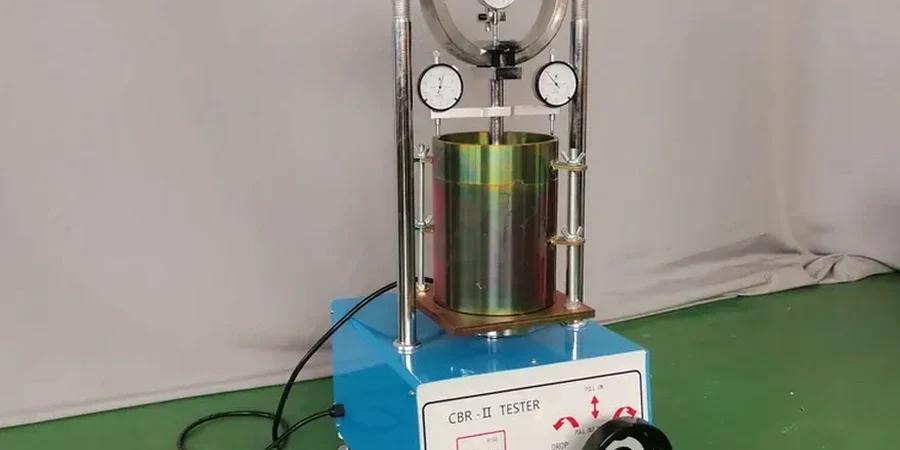
The CBR press in our laboratory — a motorized loading frame with a calibrated 10,000-pound load cell and a displacement transducer reading to 0.001 inch — applies the penetration piston at a constant 0.05 inches per minute into a specimen that has been compacted in a 6-inch-diameter mold and soaked inside a temperature-controlled water bath. In Torrance’s context, the biggest risk we catch is a false-high CBR from a sample compacted at optimum moisture content that never sees saturation: a subgrade that posts a CBR of 12 in the lab but drops to 4 after a single rainy season will produce a pavement that pumps fines through the cracks within 18 months. That is why our standard protocol for Torrance projects always includes a soaked CBR, even when the contract only requests an unsoaked value. The load-penetration curve itself tells a second story: a curve that rises smoothly indicates a well-graded, stable material; a curve that shows a sharp inflection or a plateau before 0.1 inches of penetration reveals a material that is already approaching shear failure under the confining stress, and the structural design must account for that reduced modulus.
Our services
Our Torrance laboratory CBR testing fits into a broader geotechnical program that connects subgrade strength to pavement structure and earthwork specification. The three service packages below represent the most frequent combinations requested by civil engineers and contractors working in the South Bay.
Soaked Laboratory CBR Package
Full ASTM D1883 CBR with modified Proctor compaction, 96-hour soak, swell monitoring, and load-penetration curve. Includes moisture-density relationship and corrected CBR values at both penetration depths. Delivered as a signed PDF report within 5 business days of sample receipt.
CBR + R-Value Correlation Study
For Caltrans and municipal projects requiring R-value input, we run parallel CBR and R-value tests on split samples to establish a project-specific correlation. This avoids the generic CBR-to-R-value conversion factor and produces a more accurate pavement structural number.
Subgrade Investigation with CBR Profiling
Combines field sampling via test pits or hollow-stem auger borings with laboratory CBR testing at multiple depths across the project footprint. The deliverable is a CBR contour map and a table of design CBR values per reach, recommended for Torrance street rehabilitation projects exceeding 1,000 linear feet.
Common questions
What does a laboratory CBR test cost for a typical Torrance street improvement project?
A single-point laboratory CBR test — including modified Proctor compaction, 96-hour soak, and swell measurement — runs between US$120 and US$210 per specimen. Most Torrance street projects require 3 to 6 points to characterize the subgrade variability across the alignment, so the total laboratory budget typically falls between US$500 and US$900. The cost per point drops slightly when we batch multiple specimens from the same project.
How do you select the right moisture condition for the CBR test in Torrance’s soils?
We compact the specimen at the optimum moisture content determined by ASTM D1557 (modified Proctor), then soak it for 96 hours under a surcharge weight that simulates the future pavement section. This produces the “worst reasonable case” CBR value. For Torrance’s silty sands with groundwater within 30 feet of the surface, the soaked CBR can be 40 to 60 percent lower than the unsoaked value, and we always report both so the design engineer can assess the sensitivity.
Can the laboratory CBR result be used directly for flexible pavement thickness design?
Yes — the soaked CBR value is the primary subgrade strength input for the AASHTO 1993 flexible pavement design method, which is the standard referenced by Torrance Public Works and most South Bay consulting firms. The CBR feeds into the structural number calculation, which then determines the required thickness of asphalt concrete, aggregate base, and subbase. We carry out the CBR at 0.1-inch and 0.2-inch penetration, and the lower of the two values is typically used for design conservatism.