On a recent mixed-use project off Hawthorne Boulevard, the excavation hit a layer of silty sand that looked fine-grained at first glance, but the structural engineer needed more than a visual classification to sign off on the footing design. That is exactly the scenario where a combined sieve and hydrometer analysis becomes non-negotiable. We ran the full ASTM D2487 procedure in our Torrance lab and delivered a complete particle size distribution curve within 48 hours. The report confirmed the material was SM—silty sand with 22% passing the No. 200 sieve—which changed the drainage assumptions and eliminated the need for an overdesigned retaining wall. For any project in Torrance where the soil transitions from the sandy lenses of the coastal plain to the finer alluvial deposits further inland, understanding the gradation is the first step toward a reliable bearing capacity calculation. Integrating this data with field tests like the standard penetration test gives the geotechnical engineer a full picture of the subsurface.
A particle size distribution curve is not just a lab report—it is the DNA of the soil that governs permeability, frost susceptibility, and compressibility.
Service characteristics in Torrance
Local geotechnical conditions in Torrance
The soil profile across Torrance is not uniform—the western neighborhoods near the beach sit on younger Quaternary dune sands with low fines content, while the eastern sections toward Carson transition into older alluvial deposits with significant silt and clay layers. If a contractor assumes a clean sand based on a quick field inspection and skips the hydrometer test, the consequence can be a misclassification that triggers liquefaction concerns under IBC Seismic Design Category D. A sand with 15% fines versus 35% fines behaves completely differently under cyclic loading, and the Torrance area has a history of moderate shaking from the Newport-Inglewood fault zone. In the industrial corridor along 190th Street, we have pulled samples that looked like uniform fine sand but tested as silty sand with 28% passing the No. 200—enough to require a site-specific ground motion analysis per ASCE 7-16 Chapter 21. The grain size curve is the first line of defense against these oversights.
Our services
Our Torrance soil laboratory provides several classification and index tests that complement the particle size distribution data, all under the same quality management system. Turnaround is typically 2 to 3 business days for routine projects, with expedited options available for active construction sites.
Complete Gradation Package (Sieve + Hydrometer)
Combined analysis from coarse gravel to colloidal clay fraction, reported with a semi-log particle size distribution curve and USCS classification per ASTM D2487. Includes D10, D30, D50, D60, Cu, and Cc coefficients.
Atterberg Limits Testing
Liquid limit, plastic limit, and plasticity index determination per ASTM D4318 on the fine fraction of the same sample, allowing full classification of silts and clays encountered in Torrance basin deposits.
Common questions
How much does a grain size analysis with hydrometer cost in Torrance?
A combined sieve and hydrometer analysis on a single sample typically runs between US$80 and US$180, depending on the number of sieves required, the presence of oversized particles, and whether Atterberg limits are bundled in. Bulk pricing applies for projects with 10 or more samples.
What is the difference between a sieve analysis and a hydrometer test?
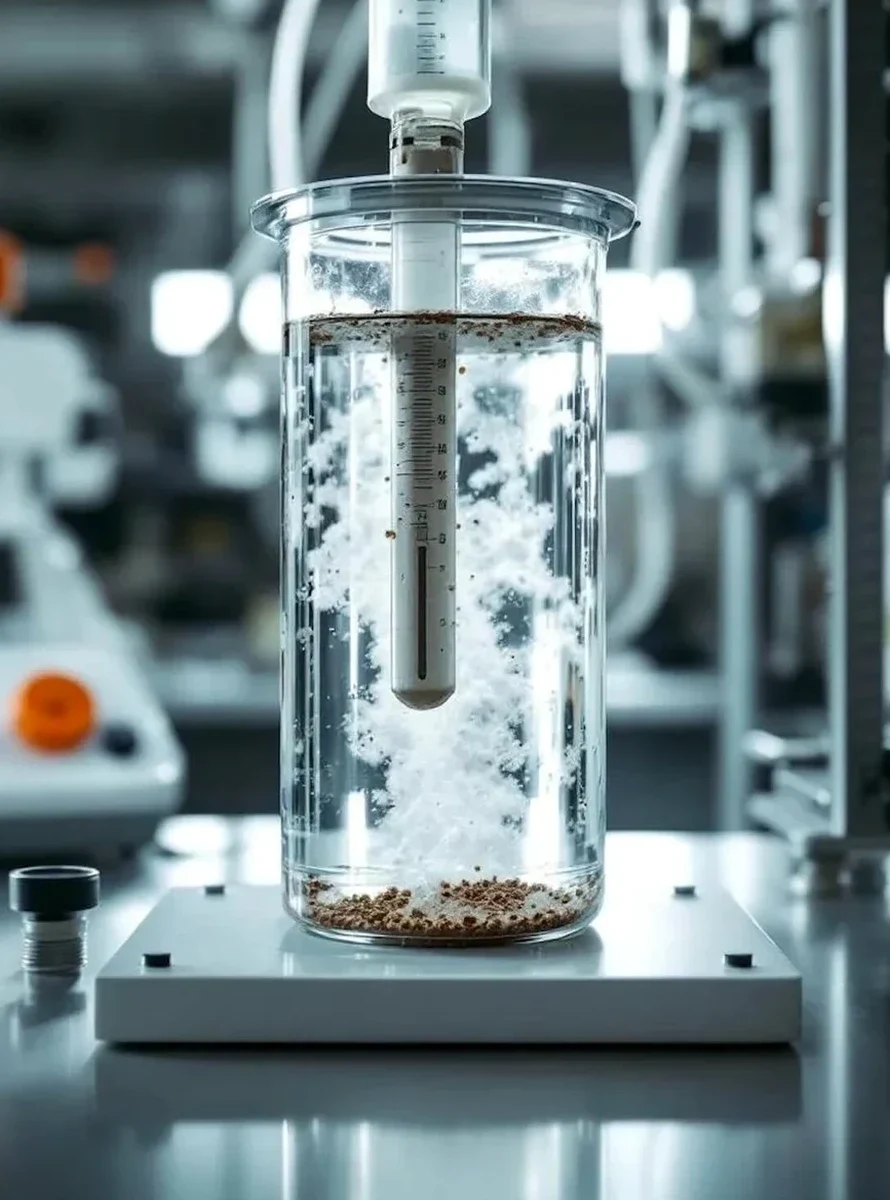
The sieve analysis covers the coarse fraction—particles retained on the No. 200 sieve (75 µm) and larger—using a stack of wire mesh sieves. The hydrometer test handles the fine fraction that passes the No. 200, measuring particle sizes down to approximately 1 µm based on sedimentation velocity in a water column with a dispersant.
When does the IBC require a hydrometer analysis in Torrance?
The IBC references ASCE 7-16 for seismic site classification, and the hydrometer becomes mandatory when the fines content (percent passing the No. 200) determines whether a soil classifies as Site Class D, E, or F. In Torrance, where the Newport-Inglewood fault influences seismic hazard, getting the site class wrong can significantly alter the design spectral accelerations.
How long does a grain size test take from sample submission to report?
Standard turnaround is 48 to 72 hours for a combined sieve and hydrometer analysis. The hydrometer portion alone requires a minimum 24-hour sedimentation period per ASTM D7928, so same-day results are not possible. For urgent foundation decisions, we can carry out preliminary sieve data within 24 hours while the hydrometer runs.
Can you test samples that contain both gravel and clay in the same run?
Yes, that is exactly what the combined method handles. The sample is first washed over the No. 200 sieve to separate the coarse and fine fractions. The retained gravel and sand go through the sieve stack, and the washed fines go through the hydrometer procedure. The two datasets are merged into one continuous particle size distribution curve covering the full range from gravel to clay.