The 1933 Long Beach earthquake reshaped how Southern California builds. In Torrance, where alluvial deposits from the LA Basin mix with shallow groundwater, a soil mechanics study is not a formality. It is the line between a foundation that settles half an inch and one that cracks open in the next seismic event. Our lab runs ASTM D2487 classification on every sample, quantifying fines content that directly affects liquefaction susceptibility under ASCE 7 Chapter 20. When we drill on Western Avenue or near the refinery corridor, we expect interbedded silts and sands at 15 to 30 feet. That layering demands consolidation testing to predict settlement under mat or deep foundations. We combine field SPT data from spt-drilling with triaxial shear strength parameters, delivering a full stratigraphic model the structural engineer can use without guesswork. Every report includes bearing capacity, lateral earth pressure coefficients, and seismic site class per IBC 1613.
In Torrance alluvial soils, fines content above 35% changes the liquefaction classification instantly. Our lab measures it layer by layer.
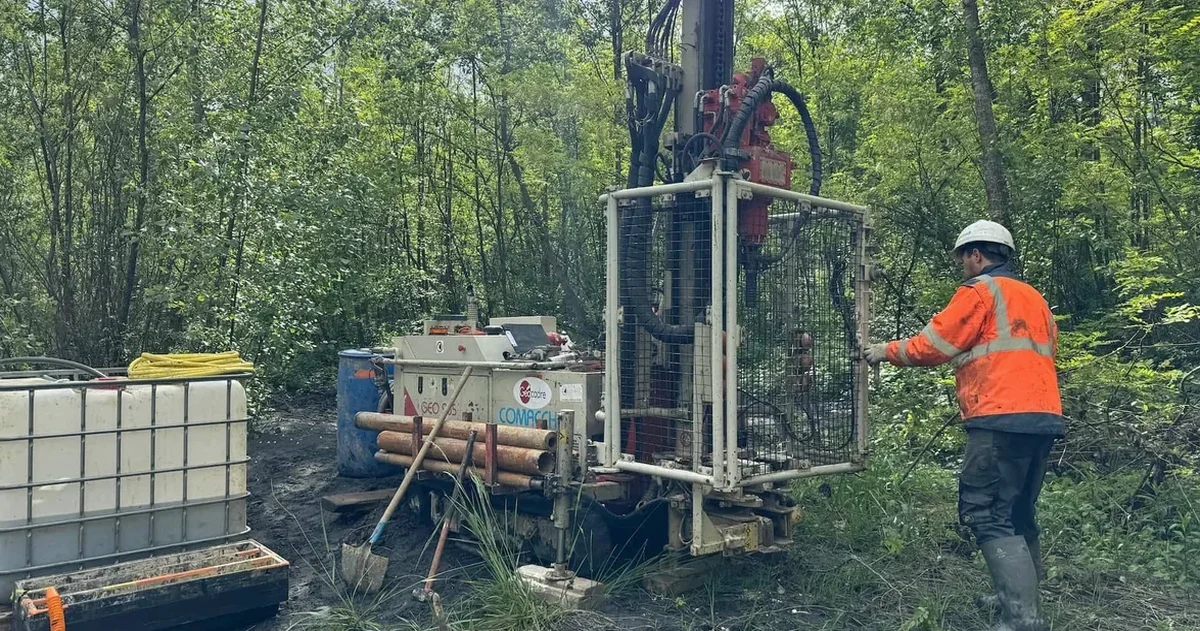
Service characteristics in Torrance
Field demonstration
Local geotechnical conditions in Torrance
Torrance grew fast after World War II, spreading across old marshland drained for housing. That compacted fill, often 4 to 8 feet thick, hides under thousands of homes and warehouses. A soil mechanics study skipped on these lots returns bearing capacity numbers that do not match reality. We have pulled samples where the fill layer contained construction debris, ash, and organics, all of which rot or compress unevenly. The deeper risk is liquefaction. The 2019 Ridgecrest sequence reminded everyone that the LA Basin transmits energy efficiently. Fine sands below the water table, mapped extensively in the Torrance area, can lose strength fast. Our lab runs cyclic triaxial tests when the SPT N-value and fines content sit in the boundary zone. The cost of that test is a fraction of the cost of litigation after differential settlement cracks a slab. City reviewers under the current Torrance building ordinance expect a site-specific response spectrum, and we carry out it.
Our services
Our Torrance lab delivers the three core analyses every geotechnical engineer needs for a complete soil mechanics study.
Classification and index testing
Atterberg limits, grain size distribution by sieve and hydrometer, and USCS classification per ASTM D2487. We report moisture content, specific gravity, and organic content when the sample warrants it.
Strength and consolidation
Triaxial compression (UU, CU, CD), direct shear, and one-dimensional consolidation. We carry out c-φ pairs, compression index, and preconsolidation pressure for settlement and bearing capacity calculations.
Common questions
How much does a soil mechanics study cost in Torrance?
Budget between US$3,010 and US$4,930 for a typical single-family lot study including drilling, lab classification, consolidation, and triaxial shear with a signed report. Larger commercial parcels or liquefaction analysis add scope and cost.
Which ASTM standards does the Torrance building department require?
Plan checkers in Torrance expect ASTM D1586 for SPT sampling and ASTM D2487 for soil classification at minimum. For foundation design they look for consolidation (ASTM D2435) and strength testing referenced in the geotechnical report. We include all relevant ASTM numbers on the lab sheets.
Do I need a liquefaction assessment for a Torrance property?
Most parcels in Torrance sit within a mapped liquefaction hazard zone per the California Geological Survey. If your boring logs show loose sands below the water table, we run the NCEER simplified procedure using SPT data and fines content from our lab to determine the factor of safety.