Torrance sits on a complex geological patchwork. Much of the city, especially areas west of Hawthorne Boulevard, rests on Quaternary alluvium and old marine terrace deposits that can extend well over 30 meters deep before reaching competent bearing strata. A 2018 microzonation study by the California Geological Survey highlighted amplified shaking potential in zones underlain by these soft alluvial soils. That reality forces every pile foundation design we develop to contend with two critical factors: the proximity of the Newport-Inglewood Fault and the long-period ground motion amplification that deep soil columns produce. The design isn't about just reaching refusal—it's about calculating how the pile group interacts with the surrounding soil during a design-level event, factoring in kinematic soil-pile interaction and potential downdrag in compressible layers.
In Torrance's deep alluvium, pile design isn't about finding rock—it's about engineering reliable friction capacity through 30 meters of soil that will move during an earthquake.
Service characteristics in Torrance
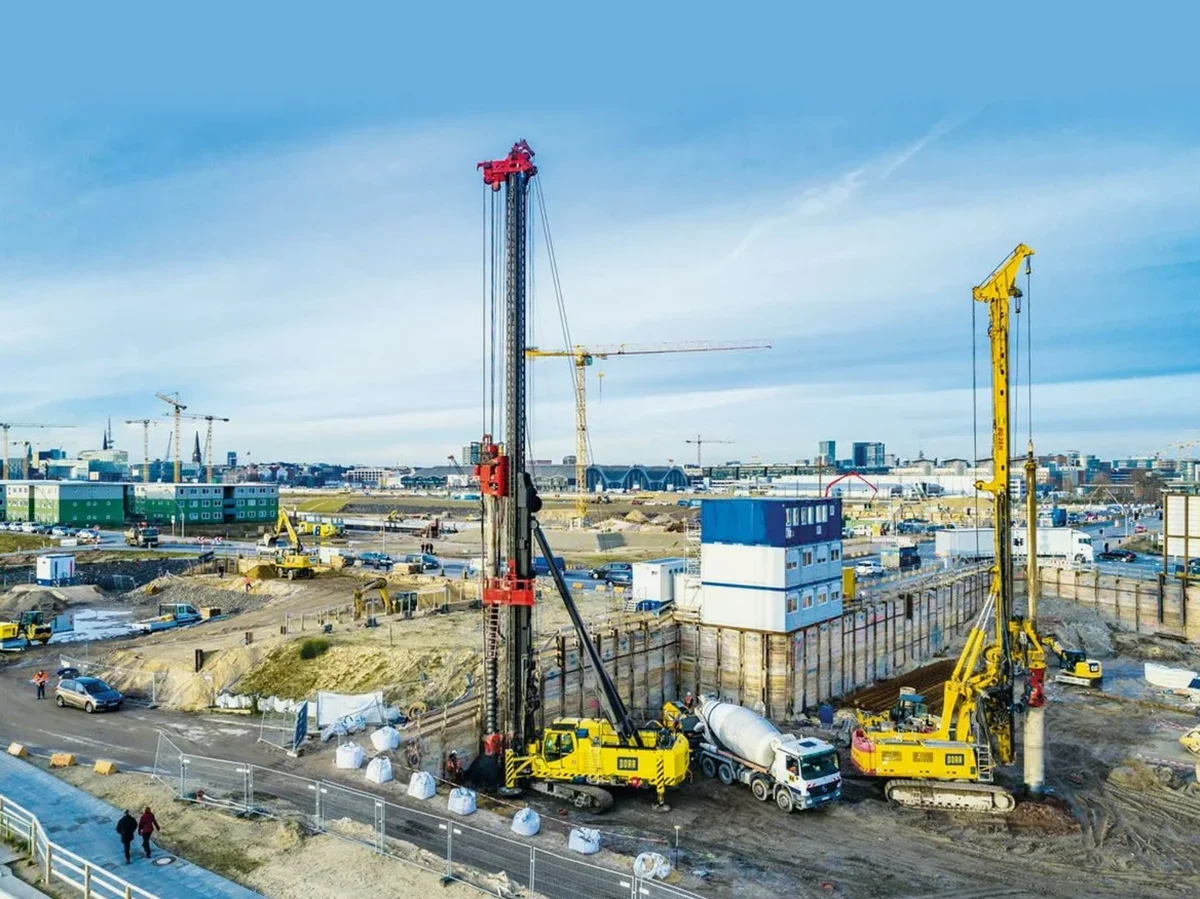
Local geotechnical conditions in Torrance
The IBC 2021, via its adoption of ASCE 7-22, requires that pile foundations in Seismic Design Category D—which covers all of Torrance—be designed for liquefaction-induced lateral spreading and loss of lateral support. The risk here is specific: the Gage Avenue corridor and areas near the Dominguez Channel have documented shallow groundwater, historically within 2–3 meters of the surface. That means even moderately dense silty sands can liquefy under the right shaking. A pile designed without accounting for the sudden loss of confining stress in the liquefied layer will buckle or shear at the interface between the liquefied and non-liquefied strata. We run nonlinear effective stress analyses in PLAXIS or FLAC, modeling excess pore pressure generation and dissipation over the earthquake duration. If the analysis shows lateral spreading displacement exceeding 75 mm, we specify reinforced concrete piles with ductile detailing through the critical zone and consider ground improvement around the pile group as a secondary mitigation measure.
Our services
Our pile design work in Torrance integrates site investigation, laboratory testing, and advanced numerical modeling. Every project starts with understanding the specific seismic hazard at the site coordinates.
Axial capacity analysis
We compute skin friction and end bearing using both API RP 2GEO methods for sands and the alpha method for cohesive layers, calibrated to local SPT and CPT data. Group efficiency factors are applied per FHWA guidelines, with settlement estimates from elastic continuum theory.
Lateral pile response and p-y modeling
Using LPILE with site-specific p-y curves derived from actual soil modulus values, we model the pile head deflection and bending moment distribution under the design lateral load. For seismic conditions, we decouple inertial and kinematic demands as required by ASCE 7.
Construction monitoring and pile integrity testing
We specify cross-hole sonic logging (CSL) or thermal integrity profiling (TIP) for CIDH piles, and review pile driving records for driven piles. Our inspectors verify that the installed pile meets the design tip elevation and that the shaft integrity matches the design assumptions.
Common questions
How deep do piles typically need to go in Torrance to bypass the soft alluvium?
It depends on the site location relative to the old marine terrace. West of Hawthorne Boulevard, we often see competent Pleistocene-age deposits between 25 and 35 meters. East of Crenshaw, the alluvium can be shallower—sometimes 18 to 22 meters. We never assume; each design requires a site-specific boring log. The pile tip should be founded in material with an SPT N-value consistently above 30 blows per foot for end bearing piles, or achieve sufficient friction capacity in dense sand layers for friction piles.
Does the Newport-Inglewood fault affect pile foundation design in Torrance?
Yes, directly. The fault zone runs through the eastern portion of the city, and the Alquist-Priolo Act requires special studies for structures within 150 meters of a mapped fault trace. Beyond surface rupture, the fault is the seismic source for design ground motions. Our response spectra are based on probabilistic seismic hazard analysis that accounts for characteristic earthquakes on the Newport-Inglewood system. The design must consider both the short-period acceleration that affects the structure and the long-period motion that drives soil column amplification.
What type of pile is most common for commercial buildings in Torrance?
Cast-in-drilled-hole (CIDH) piles, typically 24 to 36 inches in diameter, are standard for mid-rise commercial projects. They handle the lateral demands well and allow inspection of the bearing stratum through the drilling bucket. For lighter structures or sites with very high groundwater, we sometimes recommend auger-cast piles with a grout column placed under pressure. Driven precast concrete piles are less common here due to noise restrictions in commercial zones and the difficulty of penetrating dense Pleistocene gravels without pile damage.
What is the typical cost range for a pile foundation design in Torrance?
For a complete geotechnical investigation and pile foundation design package—including drilling, lab testing, engineering analysis, and the sealed design report—project costs generally range from US$1,890 for a straightforward single-family residential pile design to US$6,600 for a detailed commercial project requiring advanced numerical modeling and liquefaction analysis. The final cost depends on the number of borings, the depth of exploration, and the complexity of the seismic analysis required by the City of Torrance building department. More info.