The most common mistake we see in Torrance is specifying a wall section before understanding what lies beneath the top two feet of fill. Contractors assume the native Palos Verdes sand will take the load, only to discover lenses of hydromuscovite clay — a mineralogy typical of the San Pedro Formation — that swells after a single rain event. The wall heel lifts, the face cracks, and the homeowner is looking at a claim. We design retaining walls by first mapping these transitions with field data from SPT drilling to quantify stiffness at key depths, then selecting a stem and base geometry that works with the soil, not against it. In a city where basement excavations and split-level additions are common on lots sloping toward the Pacific, getting the earth pressure distribution right on paper saves tens of thousands in repairs later.
A Torrance wall without a drainage blanket behind the stem is a future failure — hydrostatic pressure in the rainy season triples the overturning moment overnight.
Service characteristics in Torrance
Local geotechnical conditions in Torrance
In Torrance, many hillside lots graded in the 1960s and 1970s used uncontrolled fill that was never engineered. We often find brick fragments, asphalt chunks, and wood debris at depths of three to eight feet — material that consolidates unevenly under a wall footing. If the design assumes uniform bearing on natural ground but the toe sits on this fill, differential settlement opens vertical cracks at the wall corners within the first two years. An even bigger threat is global instability: a wall built near the top of a slope in the Hollywood Riviera neighborhood can trigger a deep-seated failure plane if the reinforcement length doesn't extend past the critical circle. Our design process always includes a slope stability back-analysis using Spencer's method for walls within two times the wall height from a descending slope.
Our services
Our Torrance retaining wall practice covers the full spectrum from feasibility to construction support, always grounded in the geotechnical conditions of the South Bay.
Cantilever and Gravity Wall Engineering
Complete structural and geotechnical design for cast-in-place concrete, masonry, and segmental block walls up to 16 feet. Includes stem and base reinforcement schedules, key dimensions, and construction-phase observation of footing subgrade.
Anchored and Mechanically Stabilized Earth (MSE) Walls
Design of tieback anchors and geogrid-reinforced walls for tight right-of-way conditions and deep cuts. We specify tendon bond lengths based on grout-to-ground friction verified through on-site pullout testing.
Common questions
What does retaining wall design cost for a typical Torrance residential lot?
For a single-family home wall between four and eight feet tall, retaining wall design fees range from US$1,070 to US$4,400 depending on wall length, soil report availability, and seismic complexity. Projects requiring tieback anchors or exceeding ten feet fall toward the upper end.
When does a retaining wall in Torrance require a building permit?
Torrance enforces the California Building Code, which triggers a permit for any wall over four feet measured from the bottom of the footing to the top of the wall. Walls supporting a surcharge, like a driveway or pool, require engineering regardless of height.
How do you handle drainage behind the wall to prevent hydrostatic buildup?
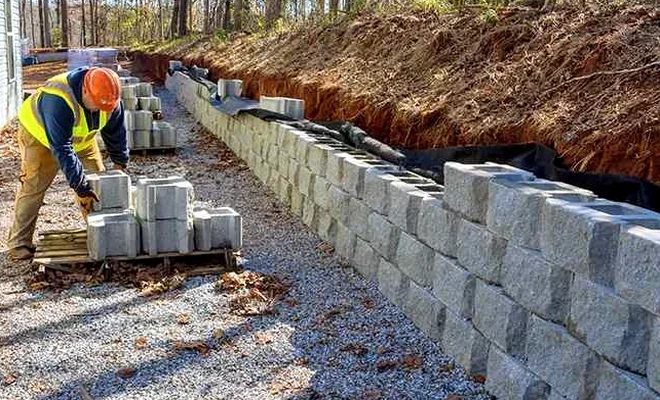
We specify a continuous drainage blanket — minimum 12 inches of clean gravel wrapped in filter fabric — with a 4-inch perforated collector pipe at the base, daylit to a suitable outlet. Weep holes alone are insufficient for Torrance's winter rain intensity and lead to staining and efflorescence on the wall face.