Torrance's transformation from expansive agricultural land to a major South Bay industrial and residential hub placed immense pressure on its underlying geology. Much of the city rests on Quaternary alluvium, with significant zones of young, compressible deposits that pose real challenges for foundation engineers. The rapid post-war boom saw warehouses and aerospace facilities rise on ground that was never ideally suited for heavy structural loads. Today, when site investigations reveal layers of soft clay or loose sand extending 15 to 25 feet below the surface, stone column design becomes the most practical ground improvement strategy. At our Torrance-based geotechnical team, we evaluate in-situ conditions using data from CPT soundings to calibrate the vibro-replacement process, ensuring each column penetrates through the weak strata and bears on competent material. Our methodology addresses the specific demands of the Los Angeles Basin's seismically active environment, where the 1994 Northridge earthquake redefined local expectations for soil performance.
A properly designed stone column grid transforms liquefiable silts into a composite mass with predictable, drainable behavior during a seismic event.
Service characteristics in Torrance
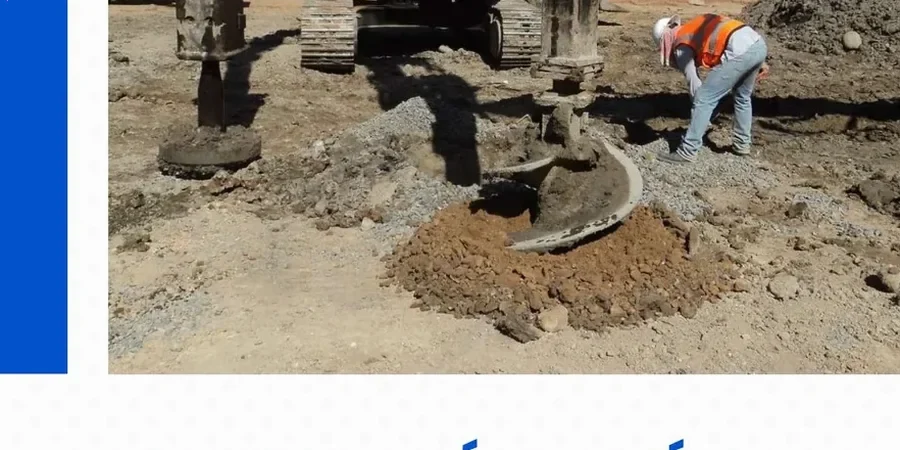
Local geotechnical conditions in Torrance
The vibroflot, a depth vibrator 12 to 18 inches in diameter equipped with an electric or hydraulic motor driving an eccentric weight, performs the actual column construction in Torrance's challenging subsurface. The risk of not designing these columns properly manifests as either excessive total settlement or unacceptable differential movement between isolated footings. In the loose, potentially liquefiable sands mapped across western Torrance near the Pacific Coast Highway corridor, a poorly executed grid can leave untreated pockets that trigger localized bearing failures during a moderate earthquake. We witness this risk most acutely during the wet winter months of El Niño years, when the groundwater table rises to within 5 feet of the surface, reducing effective stress and amplifying the potential for a vibroflot to create a 'bulb' failure instead of a clean, continuous column. Our field engineers monitor amperage and pull-down pressure in real time to ensure each lift achieves refusal criteria, preventing the hidden defect of a necked column that would compromise the entire treatment block.
Our services
Our stone column design package integrates seamlessly with the broader geotechnical scope required for Torrance building permits. Each service below targets a specific phase of the ground improvement lifecycle.
Liquefaction Analysis & Column Layout
We compute the factor of safety against liquefaction using SPT-based or CPT-based triggering procedures, then optimize the column grid spacing to achieve a post-treatment FoS of at least 1.3 for the design earthquake.
Composite Ground Settlement Modeling
Using the Priebe method and calibrated finite element models, we predict total and differential settlement under the proposed foundation loads, accounting for the stiff column-soil interaction effect.
Post-Installation QA/QC Testing
We design and execute the field verification program, including modulus plate load tests on single columns and groups, to confirm the as-built conditions match the design intent before foundation construction proceeds.
Common questions
What is the typical cost range for a stone column design package for a Torrance commercial lot?
For a standard commercial lot in Torrance, the engineering design package, including the liquefaction analysis, column layout drawings, and construction specifications, typically falls between US$1,350 and US$5,970. The final fee depends on the building footprint size, the complexity of the subsurface profile, and the number of verification tests required by the City of Torrance Building & Safety Division.
How deep do stone columns typically need to go in the Torrance area?
In the Torrance basin, stone columns usually extend between 15 and 35 feet deep. The exact depth depends on the location of the competent bearing stratum, which we identify through CPT soundings. Near the Madrona Marsh area, we often find compressible layers extending to 25 feet, requiring columns to fully penetrate the soft zone.
Can stone columns be installed next to existing structures in Torrance?
Yes, but we must use a low-amplitude vibroflot and a predrilling technique in some cases to avoid vibration-induced settlement of adjacent footings. For projects near sensitive facilities like the Torrance Memorial Medical Center, we implement a vibration monitoring plan with triaxial geophones to keep peak particle velocities below 0.5 in/sec at the nearest foundation.
What load capacity can we expect after stone column treatment in Torrance soils?
For the typical alluvial soils in Torrance, a well-designed stone column grid can support bearing pressures between 4,000 and 8,000 psf for shallow footings. The capacity depends on the replacement ratio and the undrained shear strength of the surrounding matrix. We confirm the design value with a full-scale modulus test at the site before releasing the foundation for construction.