The Palos Verdes Peninsula's ancient marine terraces define much of the subsurface character across Torrance, where Pleistocene-age Lakewood and San Pedro formations dominate the geological profile. These interbedded sands and silty clays demand precise shear strength measurement for any structural design near the Newport-Inglewood fault zone, a tectonic feature that runs roughly parallel to the city's eastern boundary. In our expertise, standard penetration testing alone rarely captures the drained versus undrained behavior that governs excavation stability in this part of Los Angeles County. A properly executed triaxial test provides the failure envelope that geotechnical engineers need to model foundation performance under both static and seismic loading conditions. We routinely combine triaxial testing data with CPT profiling to correlate in-situ response with the laboratory-derived effective friction angles and cohesion intercepts that inform shallow footing design throughout the South Bay basin.
Effective stress friction angles in Torrance's marine terrace deposits typically range from 28 to 34 degrees, but site-specific triaxial testing is the only reliable way to nail that number down.
Service characteristics in Torrance
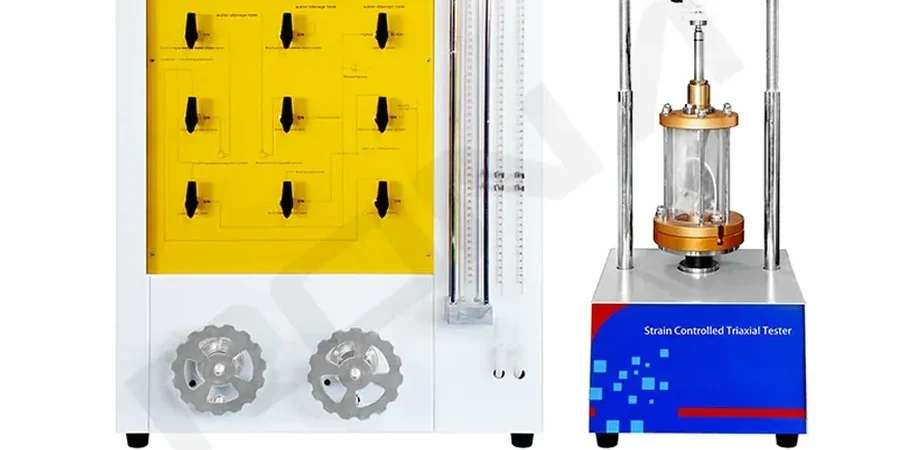
Local geotechnical conditions in Torrance
The most frequent mistake we encounter in Torrance is when design teams assume a single set of shear strength parameters across an entire site without accounting for the lateral variability of the Lakewood Formation—the stiff overconsolidated clay lenses can sit directly adjacent to pockets of looser alluvial sand, and using total stress parameters from unconfined compression alone routinely overestimates short-term excavation stability. This becomes particularly dangerous on mixed-use podium projects along Hawthorne Boulevard or Carson Street, where excavation depths of 15 to 25 feet intersect multiple stratigraphic units with markedly different drainage characteristics. A consolidated-undrained triaxial test program with pore pressure measurement reveals whether the soil will generate positive or negative excess pore pressures during shearing, which directly influences the design of shoring systems and the sequencing of basement construction. Without this data, temporary slopes can fail during excavation even when the factor of safety calculated from simpler methods suggested adequate stability.
Our services
Our triaxial testing program in Torrance is structured around the specific demands of the local stratigraphy and the regulatory requirements of the city's Building and Safety Division. Each project begins with a review of the boring logs and the proposed foundation type to determine whether consolidated-undrained, unconsolidated-undrained, or consolidated-drained protocols best match the construction sequencing and drainage conditions.
Consolidated-Undrained Triaxial (CU)
Isotropic consolidation followed by undrained shear with pore pressure measurement. This is our go-to protocol for the silty clays and clayey silts of the Lakewood Formation, providing effective stress parameters used in long-term settlement analysis and seismic deformation modeling for Torrance's Design Category D structures.
Unconsolidated-Undrained Triaxial (UU)
Rapid shear without consolidation or drainage, yielding total stress parameters applicable to short-term excavation stability and temporary shoring design. We recommend this test for the saturated alluvial sands encountered in Torrance's coastal zone where rapid loading during construction governs the critical failure mode.
Multi-Stage Triaxial with Stress Path Control
A single specimen tested at multiple confining pressures to define the Mohr-Coulomb failure envelope efficiently. Particularly valuable for deep excavation projects along the Hawthorne Corridor where the stress path during staged excavation follows a complex unloading trajectory that standard single-stage tests cannot replicate.
Common questions
What type of triaxial test does the City of Torrance require for foundation design reports?
The city's Building and Safety Division reviews geotechnical reports against the current IBC and ASCE 7 requirements, which for Seismic Design Category D structures typically require effective stress shear strength parameters. This means consolidated-undrained triaxial testing with pore pressure measurement per ASTM D4767 is expected for cohesive foundation soils, while consolidated-drained or direct shear testing may supplement the program for granular layers. The specific number of tests depends on the subsurface variability encountered in the borings—sites crossing multiple units of the Lakewood Formation generally require a minimum of three to five triaxial specimens per distinct stratum.
How long does a triaxial test program take from sample delivery to final report?
A standard consolidated-undrained triaxial test on a single specimen requires approximately five to seven working days from sample trimming through final data reduction. The saturation and consolidation phases alone can take 48 to 72 hours for the low-permeability clays common in Torrance's marine terrace deposits. A full multi-specimen program for a typical commercial foundation report is usually delivered within three to four weeks, though we can accommodate accelerated schedules when the project timeline demands it.
What sample quality do you need for triaxial testing, and can you accept Torrance-area samples?
We require undisturbed samples obtained with Shelby tubes or thin-walled samplers following ASTM D1587 procedures, with the tubes properly sealed, labeled, and transported in cushioned containers to minimize disturbance. The Lakewood Formation clays sampled in Torrance can be sensitive to handling—samples that expertise drying or vibration during transport often yield friction angles 2 to 4 degrees lower than undisturbed specimens. Our team coordinates directly with local drilling crews to ensure chain-of-custody and sample preservation from the field to our laboratory.
What does triaxial testing cost for a Torrance project?
Triaxial test programs in Torrance typically range from US$2,160 to US$2,790 depending on the number of specimens, the confining pressure stages required, and whether consolidated-undrained or multi-stage protocols are specified. A standard three-specimen CU program with pore pressure measurement falls within this range, with consolidated-drained testing at the upper end due to the extended shear phase. We carry out detailed proposals after reviewing the boring logs and confirming the applicable ASTM standards for the project.
How do you handle the effective stress analysis for Torrance's high groundwater conditions?
Torrance's coastal plain experiences seasonal groundwater fluctuations that can place the phreatic surface within the foundation influence zone, particularly in the neighborhoods between Anza Avenue and the Torrance Airport. Our triaxial testing program applies back-pressure saturation until the Skempton B-value reaches at least 0.95, ensuring that pore pressure response during shear accurately reflects fully saturated in-situ conditions. The resulting effective stress parameters—cohesion intercept and friction angle—are then used directly in drained and undrained stability analyses that account for the design groundwater elevation specified in the geotechnical investigation.